
Make an appointment for treatment
Hello everyone. I’m writing about our results after 10 days of the second stage. I am mother Tatyana, a psychologist, supervisor, and lecturer in psychology. My son Timur is 9 years old, in 4th grade of external studies. We are from Nikopol, IDP from Volosske.
Brief case history:
• Since age 2, after a neurovirus, we’ve been under constant treatment in various clinics;
• By August 2024, Timur began to experience complications — epileptic activity appeared on EEG, irritability peaked, and as a result — self-aggression. Complete exhaustion and a loss of will to live;
• In September, we came urgently for treatment — the condition was unmanageable, doctors prescribed tranquilizers. We did not give them to the child. We went directly to Professor Vagif Rakhmanov;
• After the 1st stage and three days of post-treatment support, Timur’s condition completely normalized. A new EEG showed no epileptic activity. His wellbeing was restored: he regained the will to live, started making plans, gained stamina, and new learning achievements appeared. Everything changed radically;
• We came to the second stage already with standard ADHD. We are working on strengthening the nervous system and developing higher mental functions.
Briefly on new results:
• He became interested in verbal information: listens with interest and reads stories, parables, and fairy tales on his own — something that hadn’t happened for years (improvements in attention, figurative thinking, imagination as a psychological process, and auditory and reading comprehension);
• Interest in clay modeling and drawing returned;
• “Unexplained” stress-induced heat episodes (vegetative symptoms) stopped;
• Over 10 days, we passed through 2 more “flare-up” peaks — we are now observing the emergence of new functions and readiness for new forms of interaction and self-control;
• He had a virus but endured the fever without spasms (previously vascular spasms were common);
• He became more active — lively, curious, and eager to test reality.
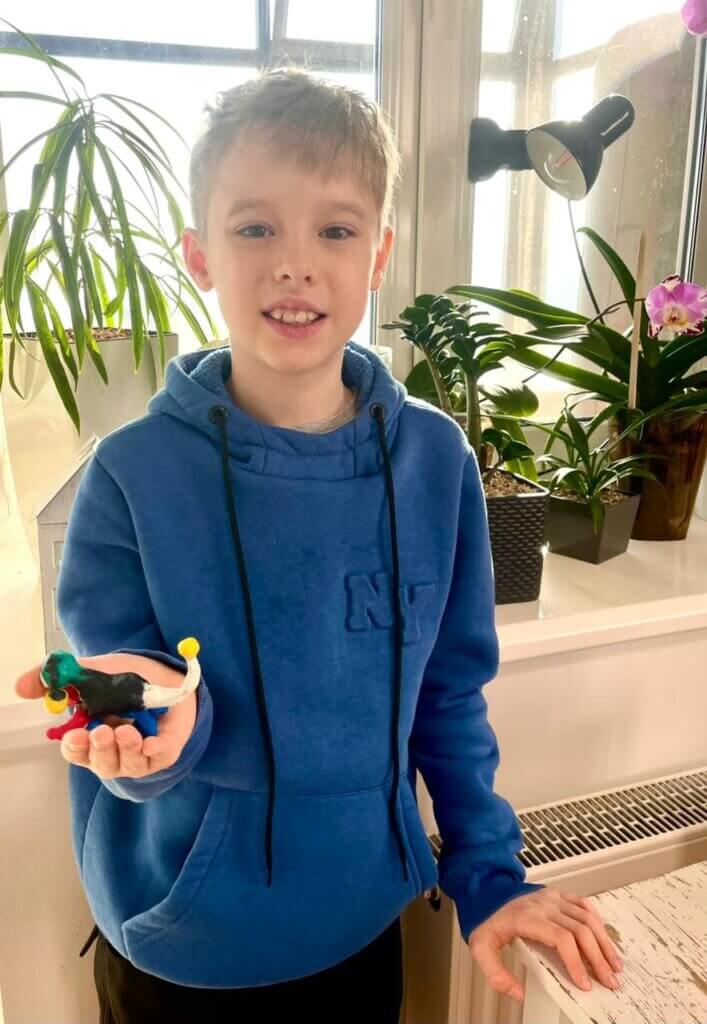
For myself, I outlined a few rules during the treatment process. In theses:
1. Listen to every word of the Professor as if I were a student. “Being a smart grown-up” comes later. Resetting to the learner’s state is essential to forming new patterns.
2. Following instructions is not for the Professor’s sake, but for our own results.
3. In this space, one must be ready to change. Rigidity is maladaptive and destructive for both children and adults.
4. Anything that seems difficult to carry out — these are growth points, and they should be done first and with double dedication.
5. Anything that feels “too harsh” is just hitting a block or resistance. Systems protect their stability — even destructive ones. This will pass. Keep moving forward and stay open.
6. Vagif Rakhmanov does almost all the work for us. But we bear the hardest task: opening the door to our fears and seeing our own dysfunctions. “It’s hard” just means we’re in the process, not lost in illusions.
7. The psyche is adaptive by nature. Any dysfunction signals the need for a replacement function. First, remove the substitute (quasi-function), and only then work on correcting the dysfunction.
8. Everything that already disturbs us must be intentionally replaced with something desired. Otherwise, it will be replaced with something random.
9. To achieve new results in treatment, we must also identify what should change in the family. The family, as a system, is adaptive and won’t allow progress without internal transformation.
10. If the system is failing, we must look for not only dysfunction, but tension. Tension in one family member always affects others. It must be channeled into improvement — resolving internal conflicts and shifting from interpersonal struggles to shared goals.
11. A woman is, symbolically, a vessel of life energy and potential for growth. She carries the responsibility of transforming dysfunctions into functions — a symbolic rebirth. For this she needs optimism, persistence, and determination (in therapy terms — as the archetype of the Great Mother). A woman stuck in a “forever girl” or victim mindset can’t transform. A mentally “over-masculinized” woman is also a distorted archetype. But a woman in the mother role — she can do anything within her system.
12. Without a man, a woman cannot access her full feminine potential — including archetypally. Balance in the family relationship is essential for maximum healing outcomes.
13. Vagif Rakhmanov does colossal work with the psyche of every participant. The group dynamics he launches and coordinates are individualized for each person. I would recommend this space as essential practice for every psychologist and psychotherapist.
Sincere gratitude!